
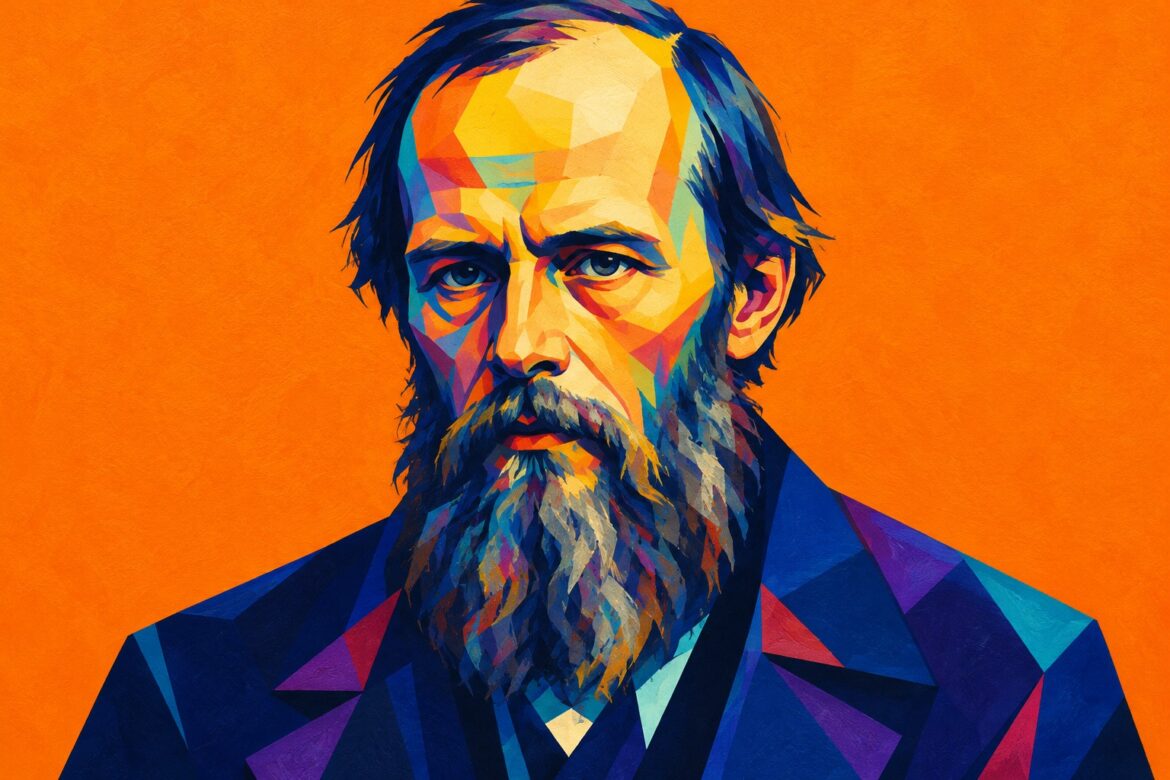
Fyodor Dostoevsky (1821–1881) wrote novels in which murderers, forgers and epileptics argue about God with the seriousness of a courtroom — and that fusion of crime, poverty and theology changed the course of twentieth-century fiction. The Encyclopædia Britannica describes him as the novelist who penetrated “the darkest recesses of the human heart”, and the list of writers shaped by his work runs from Nietzsche and Gide to Camus, Sartre and Malraux. Before any of those names, though, stands a life that explains the method: the son of a charity-hospital doctor who was sentenced to death, reprieved at the foot of the firing squad, sent to a Siberian prison camp, then nearly ruined by gambling and creditors — and turned every one of those episodes into literature.
What you will read in this article:
Born in the hospital for the poor
Dostoevsky was born in Moscow on November 11, 1821 (October 30 by the old calendar). His family did not belong to the landed gentry, a difference he often stressed when measuring himself against Tolstoy or Turgenev. His father, Mikhail, was a retired military surgeon attending charity cases at the Mariinsky Hospital for the Poor in Moscow while keeping a private practice; his mother, Maria Nechayeva, came from a merchant family. From the old-fashioned family piety that Britannica sets against the fashionable skepticism of the gentry came the religious attachment he kept for life.
In 1828 his father earned the rank of nobleman and, in 1831, bought a country estate where Fyodor spent his summers. His mother died in 1837; his father died suddenly in 1839, while the son was a student at the Academy of Military Engineering in St. Petersburg. Decades later, a story surfaced that the old man had been murdered by his own serfs — but many scholars now regard that account as a myth, not an established fact.
The engineer who quit his commission
The father’s plan was an army-engineering career for his sons. Fyodor completed the formal part: he graduated in 1843, was commissioned as a sublieutenant — and within a short time resigned to live by his pen. It was a risky decision that kept him chronically short of money. His early reading ran to Scott, Radcliffe, Schiller, Karamzin and Pushkin; his debut was a free translation of Balzac’s Eugénie Grandet, before his first original novel.
That novel, Poor Folk (1846), unfolds in letters between a poor copying clerk and a young woman who ends by marrying a wealthy, worthless man. Vissarion Belinsky, the most influential critic of the day, hailed it at once; Nekrasov proclaimed that “a new Gogol has appeared” — an episode Dostoevsky, in A Writer’s Diary, would remember as the happiest moment of his life. The same year brought The Double, the story of a clerk pursued by a double who mocks him and usurps his place — poorly received at the time, and now read as one of literature’s first studies of a split consciousness. Fame brought enmity too: his excruciating shyness and touchy vanity irritated Belinsky’s circle, and Nekrasov and Turgenev circulated a satiric poem nicknaming him “the Knight of the Doleful Countenance”.
The execution that never happened
In 1847 Dostoevsky began attending the Petrashevsky Circle, a group of intellectuals who discussed utopian socialism, and joined a related secret group devoted to revolution and illegal propaganda — motivated, according to Britannica, chiefly by his revulsion at serfdom rather than any sympathy with egalitarian communism or terrorism. On April 23, 1849, he and the other members were arrested. Eight months later, on December 22, the prisoners were led without warning to Semyonovsky Square, where a sentence of death by firing squad was pronounced and the first three were tied up in front of the guns. At the last possible moment a messenger arrived: the tsar had commuted the sentence. The whole ceremony was itself part of the punishment; one prisoner went permanently insane on the spot, and another — Dostoevsky — went from the square to write Crime and Punishment.
Those minutes under a certainty of death run through his entire work: Prince Myshkin, in The Idiot, describes the state of mind of the condemned man with an authority readers knew was testimonial. The formal sentence was four years of hard labor in Siberia followed by an indefinite term as a soldier. His first epileptic seizures struck in prison and recurred for the rest of his life — the descriptions of the aura preceding a crisis, in The Idiot, come from that experience. Siberia also produced what he called the “regeneration” of his convictions: he came to distrust intellectuals who wanted to impose political ideas on society, and he saw in the common people, bound to Russian Orthodoxy, a dignity that the reformers’ systems ignored.
From a house of the dead to a bankrupt magazine
Back in Russia, he threw himself into publishing. With his brother Mikhail he edited two influential journals, Vremya (1861–63), closed by the government over an objectionable article, and Epokha (1864–65), which collapsed with Mikhail’s death. The decade also produced The House of the Dead (1861–62), a novel built on the prison years: guards who enjoyed cruelty for its own sake, criminals capable of anything and, in the middle of the filth, decent souls. Tolstoy considered it Dostoevsky’s masterpiece, and Britannica traces the modern prison-camp novel and the dystopia back to this book.
Before all that, in 1857, he had married Maria Isayeva, a consumptive widow; the unhappy marriage began with her witnessing a seizure on the honeymoon and ended with her death in 1864 — the same year Mikhail died. In mourning and bankrupt, Dostoevsky answered in 1864 with Notes from the Underground, a novella in which a bitter, unnamed narrator attacks the idea that human psychology has laws, that people are predictable, and that a utopian society can be engineered on such laws. It is a direct rejoinder to the reformers’ rationalism and, in particular, to Nikolai Chernyshevsky’s utopian novel What Is to Be Done? (1863).
The 1860s were also years of debt and western Europe: Dostoevsky traveled abroad for culture, for an affair with the writer Apollinaria Suslova, and for a ruinous addiction — gambling. An unscrupulous publisher, Stellovsky, offered an advance on condition he deliver a novel within months, counting on forfeit clauses that would give him the rights to all his works. With less than a month left, Dostoevsky hired a stenographer and dictated The Gambler (1866), a novel based on his addiction and his relationship with Suslova. The stenographer, Anna Grigoryevna Snitkina, married him in 1867, put his finances and household in order, and created stable conditions for the family’s work — four children, of whom two survived to adulthood.
Crime, punishment and the perfectly good man
Written alongside The Gambler, Crime and Punishment (1866) follows Raskolnikov, a poor intellectual who decides to solve all his problems at a stroke by murdering an old pawnbroker. The theories that drive him to the crime are taken seriously: utilitarian morality would call the killing a positive good, since her money could help many; Raskolnikov’s favorite theory divides humanity into ordinary people and extraordinary ones — the latter holding “the right to transgress,” without which progress would be impossible. It is precisely the doctrine Dostoevsky rejects in the name of the infinite worth of each soul. The detective Porfiry plays psychological cat and mouse with a suspect he cannot prove guilty; Sonya, a prostitute moved by Christian goodness, leads him to confession and to Siberia. His friend Razumikhin embodies another answer: neither grand ideas nor dramatic gambles, but slow, steady work. It is Razumikhin, drunk at his friend’s bedside, who defends the mistake of one’s own:
“To go wrong in one’s own way is better than to go right in someone else’s.”
Crime and Punishment, Part III, chapter I (Constance Garnett’s translation). The words belong to Razumikhin, a character — not to Dostoevsky as an aphorism, a distinction usually lost in quote collections.
The Brothers Karamazov and the last wager
Then came The Idiot (1868–69), an attempt to portray a perfectly good man in a psychologically convincing way — Prince Myshkin, whose very goodness brings disaster on nearly everyone around him; The Possessed (1872), a political novel drawn from the real case of the revolutionary Nechayev, where the manifesto of the totalitarian century is compressed into Shigalyov’s formula (“Starting with unlimited freedom, I arrive at unlimited despotism”); A Raw Youth (1875); and A Writer’s Diary, a one-man journal in which Dostoevsky served as editor, publisher and sole contributor.
In 1880, at his peak, he delivered the Pushkin speech, publishing it immediately in a special issue of the Diary. His last novel, The Brothers Karamazov (1879–80), concentrates his standing themes — the origin of evil, the nature of freedom, the craving for faith — in the story of a father addicted to mockery and four sons. Ivan’s poem “The Grand Inquisitor”, in which Christ returns during the Spanish Inquisition and is arrested for having given men the freedom they do not want, is often ranked among the strongest pages ever written against God — included by the author, paradoxically, so that the defense of faith could answer the strongest possible adversary. And it is the elder Zosima who closes the novel’s moral argument: everyone is responsible for everyone and for everything.
One of the most repeated lines attached to Dostoevsky comes from The Idiot, and is spoken neither by the author nor as a settled maxim: in Part III, chapter V, Ippolit, a young consumptive close to death, challenges the prince before the whole company: “Is it true, prince, that you once declared that ‘beauty would save the world’?” — and proceeds to mock the idea. The sentence, quoted here in Eva Martin’s translation, is a dying spirit demanding of Myshkin the promise Dostoevsky placed in his hero’s heart. The novelist’s notebooks show the purpose behind it: the plan to portray a “positively beautiful man”, as the Russian Wikipedia entry on the phrase documents.
Other verified quotes
The opening of Notes from the Underground (1864, Part I, chapter I, in Garnett’s translation) needs no introduction and remains one of literature’s most impertinent first-person voices:
“I am a sick man…. I am a spiteful man. I am an unattractive man.”
In The Brothers Karamazov, Book II, chapter II (“The Old Buffoon”), it is the elder Zosima who speaks to old Fyodor Pavlovich, after urging him to close his taverns:
“Above all, don’t lie to yourself. The man who lies to himself and listens to his own lie comes to such a pass that he cannot distinguish the truth within him, or around him, and so loses all respect for himself and for others.”
And in the same novel, Book III, chapter III, it is Dmitri who confesses to Alyosha, caught between vice and the icon:
“The awful thing is that beauty is mysterious as well as terrible. God and the devil are fighting there and the battlefield is the heart of man.”
In quote collections these lines usually appear stripped of work, chapter and speaker — which changes their meaning: the warning against self-deception is a holy man’s rebuke to a buffoon; the praise of beauty’s terrible force is spoken by a murderer in love; the Underground opening is a narrator’s voice, not the author’s opinion. Recovering the source does not weaken the sentences; it removes the distortion.
The end and what remained
On January 28, 1881 (February 9 by the current calendar), Dostoevsky died in St. Petersburg of a hemorrhage, aged 59, shortly after reviving the Diary — of which he lived to publish a single issue. The Brothers Karamazov was finished; the promised cycle of novels on the “great sinner” never got past the plan. The legacy, measured by those who came after, is uncommon: Britannica credits his writings as a source of at least two modern genres — the prison-camp novel and the dystopia (from Zamyatin to Huxley and Orwell) — and lists Nietzsche, Gide, Camus, Sartre, Malraux and Bulgakov among his direct heirs. Camus is one of those direct heirs: see Albert Camus biography. A century of world wars and totalitarianism only sharpened the diagnosis: whoever wants to understand how freedom turns into voluntary servitude keeps opening his novels.
Sources: Fyodor Dostoyevsky — Encyclopaedia Britannica · Early works · Political activity and arrest · The Brothers Karamazov and Legacy; Russian Wikipedia — “Красота спасёт мир”; Crime and Punishment (tr. Constance Garnett, Project Gutenberg); Notes from the Underground (tr. Garnett, Project Gutenberg); The Idiot (tr. Eva Martin, Project Gutenberg); The Brothers Karamazov (tr. Garnett, Project Gutenberg); Russian original text of The Brothers Karamazov (Wikisource).
Read also:
- 8 Quotes for journalists to inspire your writing
- Albert Camus: biography, works and ideas on the absurd and revolt
- Fernando Pessoa biography: life and legacy of Portugal’s greatest modernist poet
- George Sand biography: the scandalous French novelist who defied conventions
- John Keats: The life and legacy of a romantic poet
- Lord Byron’s biography: The scandalous life of a romantic poet
- Percy Bysshe Shelley: the life and works of a romantic poet
- Simone de Beauvoir’s biography: The life and work of a feminist icon